Category: Healthcare

  • I prefer Quality of life to Quantity of life.

    A few days ago, there was a gathering of five high school classmates and the mortality rate became a hot conversation topic. All of us was born in 1963.

    According to ㆍKOSIS(KOrean Statistical Information System) data, about 25% of men born in 1963 were already dead. That was a thought-provoking issue to us, who are among 75% of survivors.

    Our conversation continued for a while with the story of dead classmates, recent health conditions, illness, and exercises.

    Life Expectancy vs Healthy Life Expectancy

    There are Life Expectancy(LE) and Healthy Life Expectancy(HALE) or Health-Adjusted Life Expectancy(HALE).

    As anyone can easily infer from the two terms themselves; LE measures the total length of life, regardless of health status. And HALE adjusts LE by subtracting years lived with disease, or poor health like injury, or disability.

    In short, LE is a indicator of the QUANTITY of life, HALE is about the QUALITY of life.

    sunset near my living place

    Based on the same source, KOSIS, my LE is about 21.4 years, whereas my HALE is about 3 to 5 years. There is a remarkable gap between the two estimates. The truth is that the gap is surprisingly wide to me.

    Compared to my peers, I tend to exercise regularly. Weight traing and yoga: 1 hour, two times per week respectively; Cardio exercise: 1 time of 2 to 4 hour every week.

    It’s main purpose is to increasse not my LE but my HALE.

    I’ve been thinking about this for a long time. The quality of life must come before the quantity of life for me. This is because I think it is a matter of human self-esteem or human dignity as an individual.

    Every sunrise has every sunset.
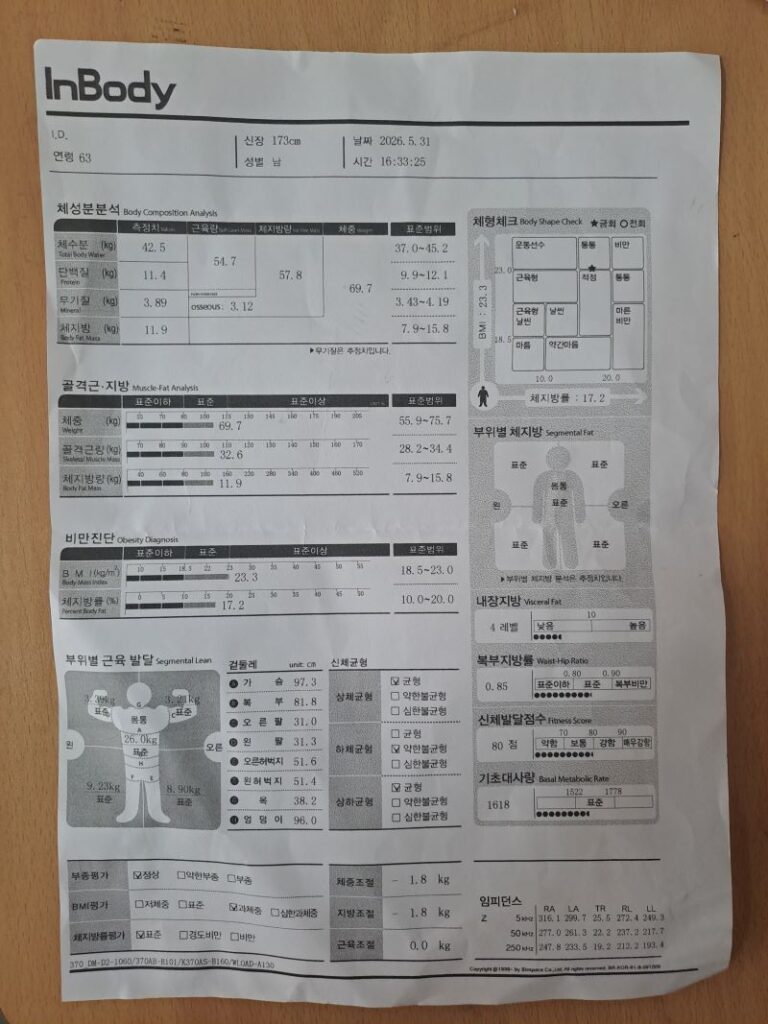
  • Assessing My Body Composition with the first InBody test

    I took my first InBody scan 10 days ago.

    The InBody device is in the gym that I’ve been doing exercises, calisthenics, and yoga.

    Yes, I do yoga. I’m the lone male in a sea of women

    The body composition tester was there since 4 or 5 years ago when I started going to the gym.

    I ignored it for years and did the InBody test for the first time.

    InBody has its limitations

    I know that InBody scanning can be hydration-sensitive due to its BIA(Bioelectrical Impedance Analysis) mechanism, and thus a degree of inaccuracy is inevitable.

    I am an engineer with experience in developing wearable products.

    In spite of that limitations, experts say that ‘Skeletal Muscle Mass’ and ’Percent Body Fat’ are key indicators.

    Here I share my data;

    Age: 63

    Gender: Male

    Height: 173 cm(5.67 ft)

    Weight: 69.7 kg(153.6 lbs)

    Skeletal Muscle Mass: 32.6 kg(71.8 lbs)

    Percent Body Fat: 17.2 %

    With this data, AI say;

    Not bad for 60s

    Body Mass Index (BMI):

    Your BMI is roughly 23.3 kg/m². This falls beautifully inside the Healthy BMI Range of 18.5 ~ 24.9.

    Percent Body Fat (PBF):

    A PBF of 17.2% falls into the “Fitness” or lean, healthy range according to guidelines from the American College of Sports Medicine (ACSM).

    Skeletal Muscle Mass (SMM):

    Your muscle mass is strong, meaning you likely have good basal metabolic function and physical strength for your 63 years.

    In short, “Not Bad.”

    Unfortunately, this time TBW is on the report. But I cannot find a reading of ECW in ECW/TBW Ratio(Extracellular Water to Total Body Water).

    Due to old version of device?

    Googling say the proper frequency of InBody scan is 2 to 4 weeks.

    Okay, reasonable for the younger.

    But, at age of 63, I guess 3 months is suitable to me.

    Because I’m neither on a diet nor has there been a big change in my workout routine.

    I’ll see what changes come in three months.